

Social emotional learning in elementary classrooms
A comprehensive synthesis of empirical research, developmental frameworks, and classroom data exploring how intentional social-emotional competence fosters academic growth and supportive learning environments. Please review the findings and share your evaluative feedback.

Social-Emotional Learning (SEL) in Elementary Education
As an elementary special education teacher, I see how frustration can affect a student’s ability to stay with a difficult task or work with a partner. For some students, asking for help, taking a break, or telling a classmate what they need takes direct teaching and repeated practice. Social-emotional learning gives me a way to teach those skills during the school day and help students use them in situations they already encounter

What is Social Emotional Learning?
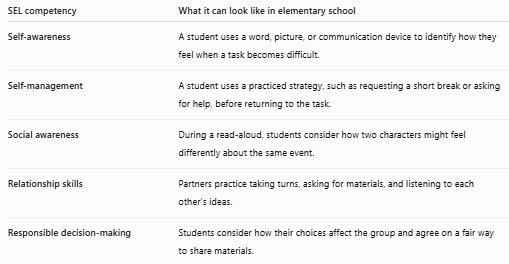
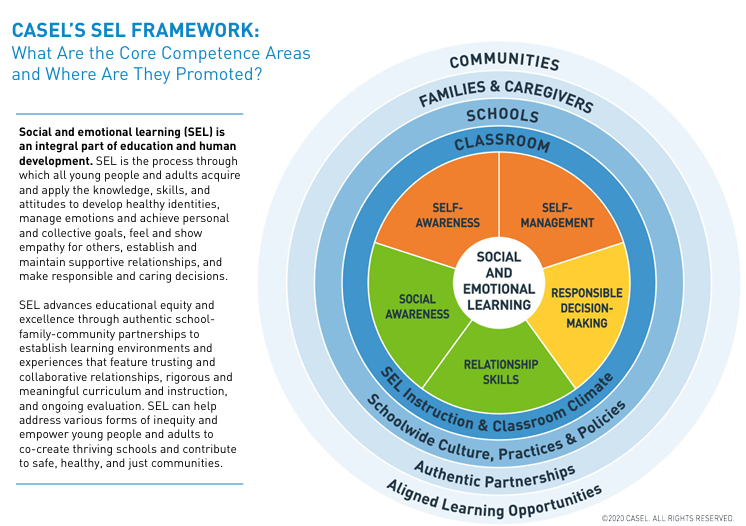
Social-emotional learning (SEL) is the process of developing skills for understanding emotions, managing reactions, building relationships, and making responsible decisions. In elementary school, teachers can model a skill, give students a chance to practice it, and prompt them to use it during routines such as partner reading, transitions, and group projects. The Collaborative for Academic, Social, and Emotional Learning (CASEL, 2020) organizes SEL into five competencies.
What Current Research and Data Show
Cipriano et al. (2023) reviewed 424 studies involving 575,361 students across 53 countries. Compared with students in control groups, students who participated in school-based SEL programs showed improvements in areas such as social-emotional skills, behavior, peer relationships, and academic achievement. Outcomes varied with the program, school setting, and quality of implementation. The review covered kindergarten through 12th grade, so its findings give me a broad picture of potential benefits. In my own classroom, I would look at how individual students use a skill across activities and settings. doi.org
In a 2026 Education Week article, Prothero reported that more than three-quarters of surveyed educators supported teaching each of four skills during the school day: self-management, cooperation, problem-solving, and effective communication. The survey included teachers, principals, and district administrators. Their responses show support for teaching these skills in school. The research review helps explain what schools might gain when students have regular opportunities to learn and practice them.
Examples of How Schools Can Implement SEL


Benefits and Challenges
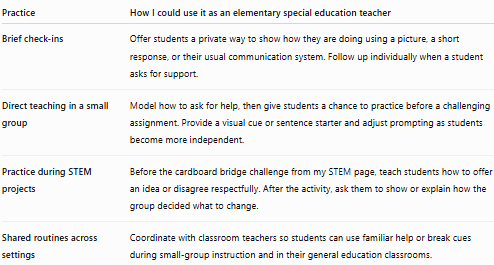
Benefits. SEL gives students practical ways to communicate what they need and stay involved in learning. A student who can request help or a short break has a strategy to use when a task becomes frustrating. Teaching these skills during real classroom activities also shows me what students can do independently and where they still need support. Visual cues, modeling, and access to students’ usual communication tools give them more ways to practice and show what they know.
Challenges. One challenge is helping students use a skill in a new setting. A student may practice asking for help successfully in a quiet small group and still need a cue during a busy classroom activity. Consistency takes planning time, staff training, and coordination. I would work with classroom teachers to choose one skill to practice across settings and look for observable progress, such as a student requesting help with fewer prompts. I would also make sure students have a way to ask for support privately.
The CASEL Wheel shows five connected areas of social-emotional learning. In elementary special education, students can practice these skills during daily routines, such as using a picture cue to request a break or taking turns during group work (CASEL, 2020).
Create Your Own Website With Webador