

Multi-tiered system of supports in elementary education
A comprehensive synthesis of current research examining why the Multi-Tiered System of Supports (MTSS) framework is fundamental to modern elementary school achievement, behavioral equity, and proactive intervention.
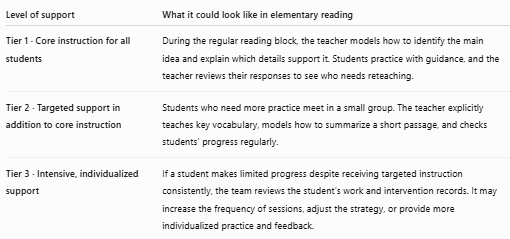
The three-tier framework breakdown
MTSS integrates academic, behavioral, and social-emotional learning into a structured, data-driven prevention continuum that serves every student according to their identified instructional needs.

Tier 1: Universal instruction
High-quality, evidence-based core instruction and proactive classroom management delivered to 100% of students, meeting the baseline needs of approximately 80–85% of the school population.

Tier 2: Targeted interventions
Supplemental, small-group academic and behavioral support providing systematic remediation and bi-weekly progress monitoring for the 10–15% of students requiring additional targeted reinforcement.

Tier 3: Intensive individualized support
Focused, high-intensity individualized interventions designed for the top 1–5% of students demonstrating significant academic difficulties or acute behavioral challenges.

Multi-Tiered System of Supports (MTSS) in Elementary Education
A third grader can read a passage aloud smoothly and still struggle to explain what it means. If I looked only at that student’s oral reading fluency score, I might miss a need for comprehension instruction. A Multi-Tiered System of Supports (MTSS) gives school teams a way to identify needs like this early, match instruction to the skill a student needs to develop, and check whether the support is working.
What MTSS Looks Like in an Elementary School
MTSS is a schoolwide framework for organizing academic, behavioral, and social-emotional support. This page focuses on elementary reading. The Center on Multi-Tiered System of Supports (n.d.) identifies four essential components: universal screening, progress monitoring, a tiered system of support, and data-based decision-making. Screening gives teachers an initial picture of student performance. Follow-up assessments and classroom work help clarify what a student needs, and progress monitoring helps the team decide whether to continue, adjust, or intensify instruction.


What Current Research and Data Show
In the 2024 National Assessment of Educational Progress (NAEP), 30% of fourth-grade public school students nationwide scored at or above NAEP Proficient in reading, down from 32% in 2022 (National Center for Education Statistics [NCES], n.d.). These national results show why elementary reading support deserves attention. At the school level, teachers still need information about individual students to decide whether to focus on decoding, fluency, vocabulary, or comprehension. nces.ed.gov
A 2026 report on Kansas City Public Schools gives a more direct example of an intervention delivered within MTSS. Hsieh et al. (2026) studied teacher-led virtual reading tutoring in a randomized trial involving 1,550 students in grades 1–4 across 14 elementary schools. Among students identified by the district as needing Tier 3 support, those assigned to tutoring scored 0.08 standard deviations higher on the end-of-year i-Ready reading assessment than their comparison peers. The difference was statistically significant, though small. The study found no statistically significant difference on the state English language arts assessment for third and fourth graders. For my practice, the results reinforce the importance of checking whether gains on one reading measure also show up in students’ everyday reading and on other assessments. National Student Support Accelerator

Classroom Example · A Third Grader Who Reads Fluently
In my third-grade reading case, the student showed a gap between oral reading fluency and performance on a Maze comprehension measure, which asks students to pick words that make sense in a passage. An informal reading inventory helped me look more closely at the difference between reading the words accurately and understanding the text.
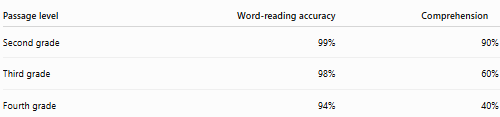
The third-grade passage stood out because the student read 98% of the words accurately and answered 60% of the comprehension questions correctly. That pattern gave me a reason to look closely at which questions the student missed and compare what the student understood after reading a passage with what they understood after hearing one read aloud.
I would use Tier 2 small-group time to teach vocabulary explicitly and model how to identify the main idea, sequence events, and make an inference using details from the passage. I would check progress with a weekly Maze measure and use brief retells to see whether the student could explain the text in their own words. I would bring both measures to the team when deciding whether to continue the intervention or change the instructional focus. The What Works Clearinghouse practice guide rates the evidence for explicitly teaching comprehension strategies in kindergarten through third grade as strong (Shanahan et al., 2010).
Benefits and Challenges
Benefits. MTSS gives teachers a way to act on early concerns and choose support based on a student’s specific needs. In this case, a general fluency intervention could take up time the student needs for comprehension instruction. Reviewing several measures gives the classroom teacher, reading interventionist, and special education teacher a clearer basis for setting a goal and deciding whether the student is making progress.
Challenges. A school needs staff, time for intervention, and regular opportunities for teachers to review data together. If sessions are frequently interrupted, it can be hard to tell whether slow progress reflects the strategy or how often the student received it. Teams also need to interpret scores in context. For example, before drawing conclusions from a low Maze score, I would look at the student’s familiarity with the task, vocabulary knowledge, listening comprehension, and classroom work. Using several sources of information takes time, but it can lead to an instructional decision that fits the student better.

This infographic shows how school teams use screening and progress monitoring to decide when to adjust instruction or provide additional support. In my third-grade reading example, I used multiple reading measures to identify comprehension as the focus for intervention.
Source: Center on Multi-Tiered System of Supports (n.d.).
Create Your Own Website With Webador